


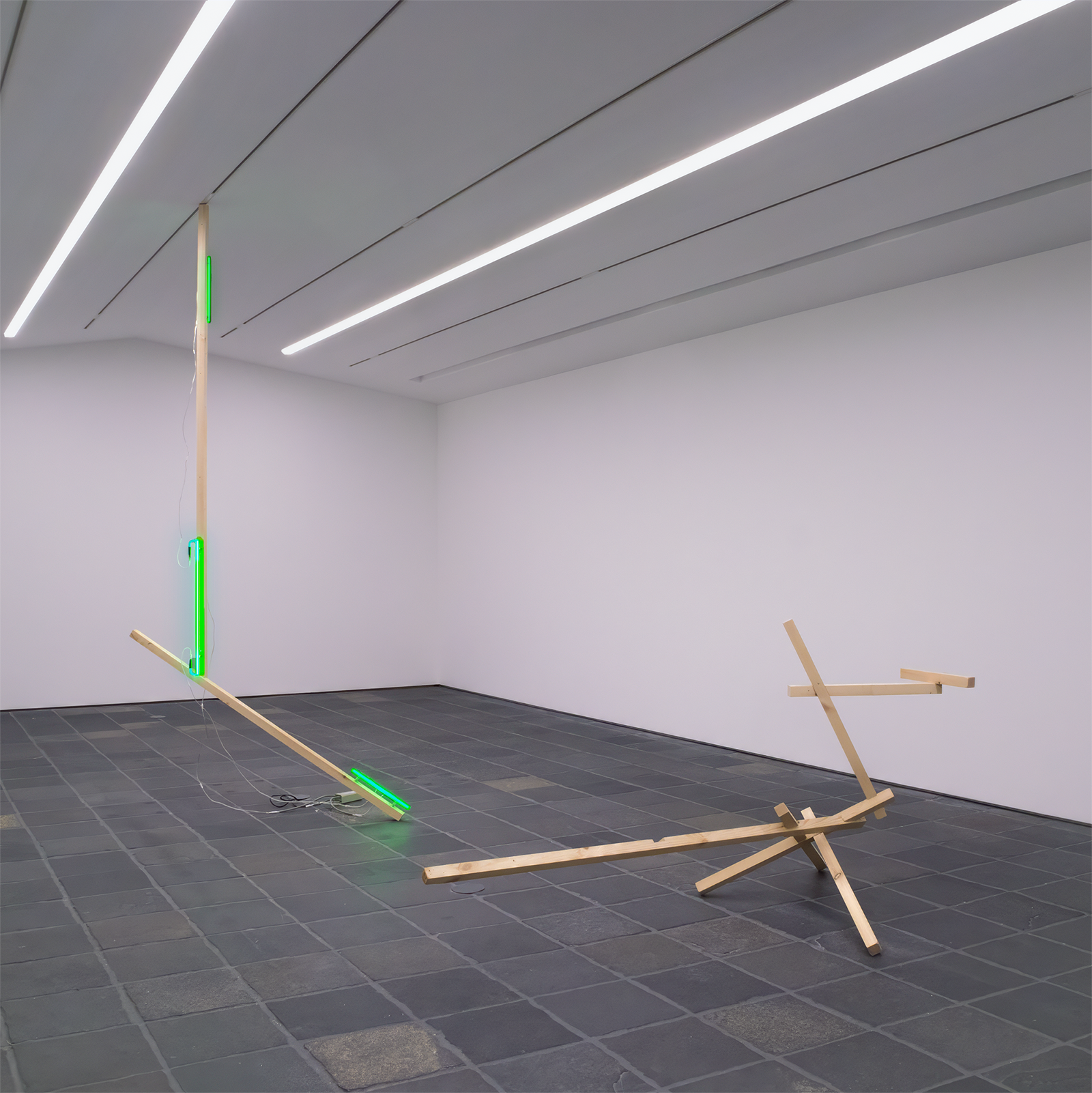
It Takes Two
The number “2” carries a special meaning.While its meaning cannot be easily condensed into words, the attempt made in this exhibition by the two artists, Takehito Koganezawa and Taku Obata, approaches that meaning.
In 1953, the double-helix structure of DNA was identified by biologists James Watson and Francis Crick. Two strands form a pair, establishing the blueprint of life. Information does not exist in isolation; it is copied and transmitted through correlation with its counterpart. Within this structure, sameness and difference are simultaneously preserved, allowing the temporal continuity of life to unfold without interruption.
A similar logic appears in Koganezawa’s paired drawing series. A single action performed along the boundary between sheets of paper produces two images simultaneously. One drawing complements the other while sustaining an alternative possibility. What emerges is a structure of images that branch like parallel universes while remaining mutually referential. Images continue to be generated through their relationship to another image.
Obata’s drawings, meanwhile, are produced through the use of a limited quantity of paint (mass.) Paint deposited on one surface is transferred to another, the trace of that movement forming the image. The trace of this movement becomes the image, and two drawings are completed at the same time. Only through the presence of two does the transfer of energy occur, and the movement of mass produces time. Within this process, a relational structure of space and time is suggested.
Within the reggae sound system culture of 1970s New York, the use of two turntables initiated a ritual practice that connected the end of one sound to the beginning of another, transforming discontinuity into continuity. In 1988, Rob Base & DJ E-Z Rock sampled and looped the beat from Lyn Collins’s debut track “Think (About It)” to produce It Takes Two.
It takes two to make a thing go right
It takes two to make it outta sight
Repeated like an incantation, this phrase is more than a hip-hop lyric.
It declares a condition through which the world itself becomes possible.
The number “2” carries a special meaning.
The attempt made in this exhibition by the two artists, Takehito Koganezawa and Taku Obata, approaches that meaning.


